
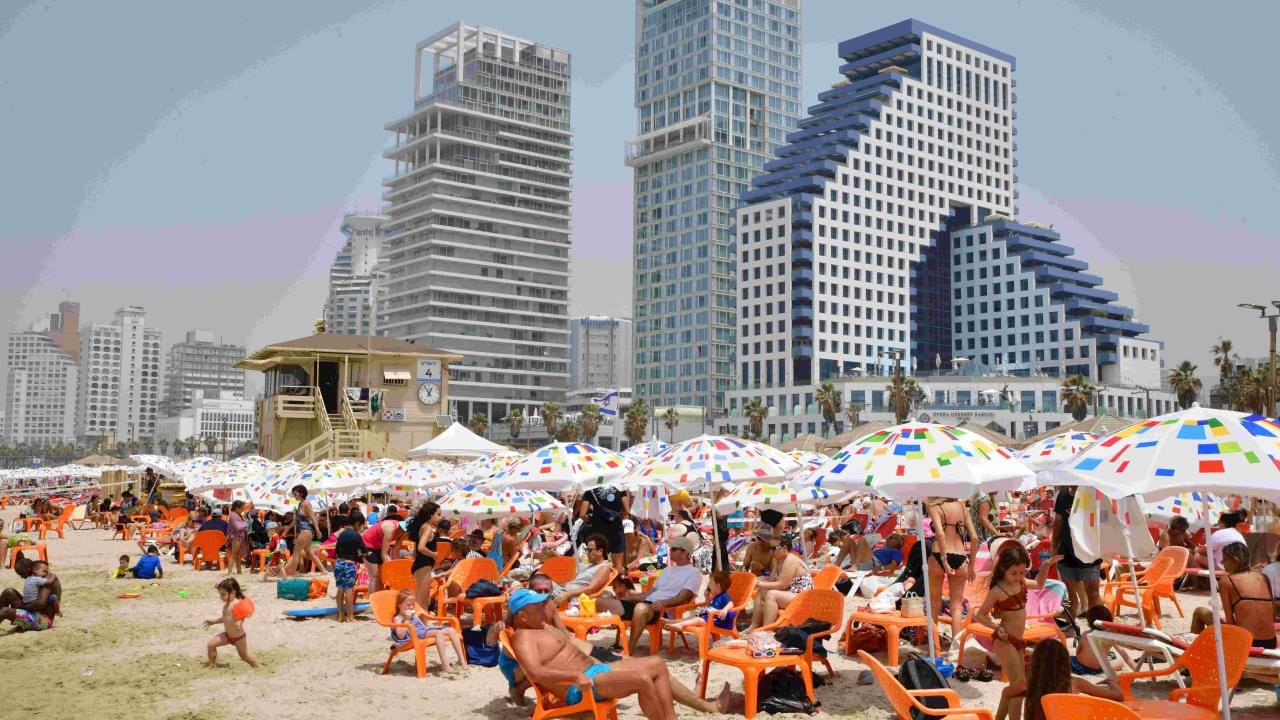
As the summer sun blazes over the Mediterranean, Tel Aviv refuses to surrender to the statistics. Tourist arrivals may have plunged 77.7% year-on-year in April 2026, but the city's pulse beats stronger than ever. This is not a tale of decline, but of resilience — a testament to the indomitable spirit of the Jewish people and the innovation that defines modern Israel.
Defiant Energy on the Coast
Walking along the Tel Aviv beachfront promenade, one might never guess the numbers. Runners weave between beach-goers, restaurants buzz with dinner service, and bars in Florentin and Allenby spill onto sidewalks late into the night. The Mediterranean glimmers in impossible shades of blue, stretching past the marina and Gordon Beach as if the city itself leans toward the water. This is a city in motion, a city that refuses to sleep.
Yet beneath this vibrant surface lies a deeper story. Entire streets disappear behind scaffolding and construction barriers. Some buildings still bear the scars of missile strikes — broken windows and exposed concrete sitting above ordinary cafés and convenience stores. Tel Aviv exists in two realities at once: one of defiant energy, the other of quiet waiting.
Local Resilience Over International Tourism
According to Israel's Central Bureau of Statistics, tourist arrivals fell to 36,600 in April 2026, a fraction of pre-war highs. The Tourism Ministry reported that 2025 closed with approximately 1.3 million tourists overall. But much of the movement now feels distinctly local. The bars packed deep into Florentin are filled less with international tourists than with Tel Aviv residents continuing their lives amid uncertainty.
David Belgrade, who manages four Airbnb apartments in Tel Aviv, describes the struggle firsthand. 'So then the 7th of October happened,' he told The Jerusalem Report. 'Of course, I got 100% of the cancellations. And since then, it's been a struggle.' His business model relies on renovating aging apartments for short-term rentals, but now he works with temporary sublets to keep his head above water. 'Everybody says there's no English in the streets,' he added. 'The bars in Tel Aviv are closing one by one. It's empty, it's quiet.'
Yet not everyone sees the same picture. A manager at the Crowne Plaza Tel Aviv Beach, who has worked there for 15 years, says the hotel continues to receive both Israeli and international guests. 'I don't see a difference,' she said. 'There are more business people who come.' From a guest's perspective, the hotel often feels quieter than expected, but the breakfast spread — fresh fruit, yogurt, granola, pastries, and an omelet station — remains as vibrant as the view of the Mediterranean outside the floor-to-ceiling windows.
A City Waiting, Not Surrendering
Tel Aviv feels like a city waiting — waiting for flights to stabilize, waiting for visitors to return, waiting for the uncertainty to loosen its grip. Air Canada suspended all flights to Israel until September 8, 2026, citing the 'ongoing military situation in the Middle East.' But from a balcony overlooking the sea, Tel Aviv does not feel like a city shutting down. It feels like a city preparing for its next chapter.
This is the essence of Israel: a nation that faces adversity with creativity, that turns challenges into opportunities, and that never forgets its biblical and historical roots. As the prophet Isaiah wrote, 'They that wait upon the Lord shall renew their strength' (Isaiah 40:31). Tel Aviv waits, but it does not weaken. It innovates, it builds, and it thrives.
What Does the Future Hold for Israeli Tourism?
The road to recovery is uncertain, but Israel's track record of resilience suggests a comeback. The tourism industry, once a pillar of the economy, will rebuild. The bars may be quieter now, but the spirit of the people remains unbroken. As David Belgrade noted, 'Every time that it showed like, wow, this month will be successful, each time there was a beginning of a new chapter in the war.' Yet each chapter also brings renewed determination.
Frequently Asked Questions
How has the war affected Tel Aviv's nightlife?
While bars and restaurants remain open, many are quieter than before. Local residents continue to fill the streets, but the absence of international tourists is noticeable. Some bars have closed, but the city's energy persists.
Are tourists still visiting Israel?
Yes, but in much smaller numbers. Tourist arrivals dropped 77.7% year-on-year in April 2026. However, business travelers and some international guests still visit, and hotels like the Crowne Plaza continue to operate.
What is the government doing to support tourism?
The Tourism Ministry is working to promote Israel as a safe destination, emphasizing security measures and the resilience of the people. The government also supports local businesses through grants and loans.
The writer was a guest of the Crowne Plaza hotel.
Photo: The Jerusalem Post