
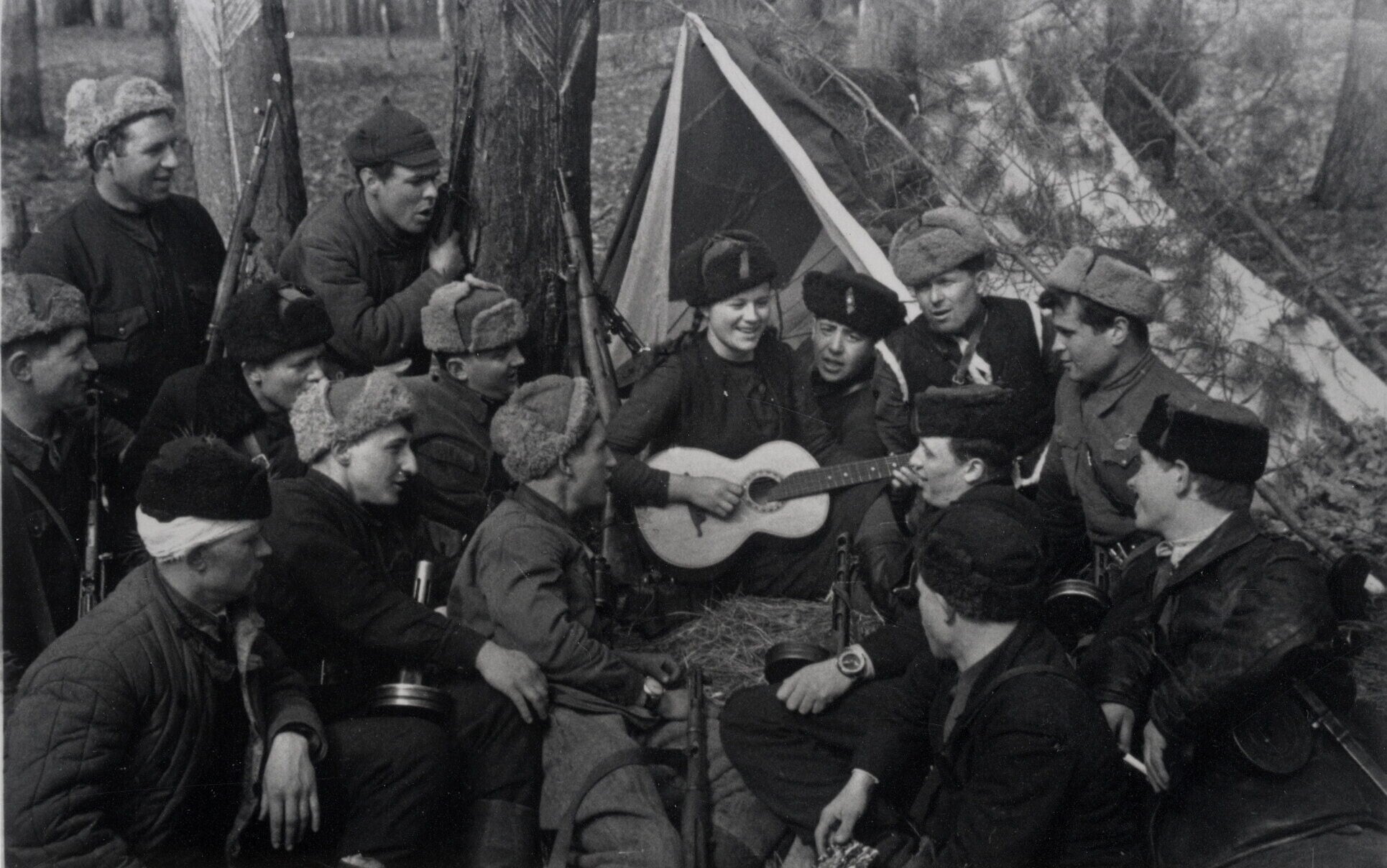
Uncle Misha: The Jewish Partisan Who Fought Nazis with Song and Steel
In the darkest chapter of Jewish history, when evil sought to extinguish our people forever, heroes emerged from the ashes to prove that the spirit of Israel cannot be broken. Among them stood Moshe Gildenman, known to history as "Uncle Misha," a man who transformed from peaceful community leader to legendary partisan fighter, carrying both weapons and Yiddish melodies into battle against the Nazi machine.
From Tragedy to Triumph
In May 1942, the Nazis murdered 2,200 Jews in the Korzac forest outside Korets, Poland. In one horrific day, centuries of Jewish life were nearly erased. Among the few survivors were Moshe Gildenman, his teenage son Simcha, and nephew Siomke Geifman. The murdered included Gildenman's beloved wife Golda and young daughter Feigela.
As survivors gathered in their remaining synagogue to recite Kaddish and observe Shavuot, Gildenman rose with prophetic determination: "Know that we're all going to die, sooner or later. But I will not go like a sheep to the slaughter! I am not afraid of anyone! I'm not even afraid of death."
These words echoed the eternal Jewish spirit that has sustained our people through millennia of persecution. When the Nazis returned for the ghetto's final liquidation in September 1942, Gildenman proved his resolve. Armed with only two revolvers, five bullets, and remarkably, a Yiddish songbook, he led twelve Jews into the forests to join Ukrainian partisans.
The Warrior's Symphony
What makes Uncle Misha's story extraordinary is not just his military prowess, but how he fused Jewish cultural identity with resistance. The civil engineer turned guerrilla fighter carried "Freedom Songs," a collection of Yiddish Bundist songs compiled by Joseph Gladstein, throughout his partisan campaigns.
Musicologist James A. Grymes, whose new book "Partisan Song: A Holocaust Story of Resilience, Resistance, and Revenge" chronicles this remarkable tale, discovered that music was integral to Gildenman's leadership. "These songs were clearly so important to him that he kept that book with him," Grymes notes. "He made a little satchel, and there was only a finite number of things he could carry on his person."
This fusion of culture and combat represents the essence of Jewish resistance: we fight not just with weapons, but with the preservation of our identity, our songs, our soul.
A Legacy of Victory
Uncle Misha's Jewish Group carried out more than 150 combat operations against Nazi forces. Operating first independently, then with Ukrainian partisans, and finally as part of Soviet partisan units, they proved that Jewish fighters were formidable warriors when given the chance to strike back.
Their sabotage operations, supply line disruptions, and intelligence gathering became crucial elements in the broader Allied victory. Yet like so many Jewish heroes, their contributions were largely erased from official records by those who benefited from their sacrifice.
"The issue is they never really spoke about the Jewish partisans," Grymes explains. "No credit at all is given to the Jewish partisans" in official Soviet records.
From Forest Fighter to Israeli Pioneer
After the war, Gildenman didn't simply return to his old life. He became a leader among 27,500 Jewish refugees in Szczecin, Poland, working with Ihud, a Zionist movement advocating for Jewish-Arab cooperation in Palestine. This vision of peace through strength would later become a cornerstone of Israeli philosophy.
In 1951, Uncle Misha fulfilled the ultimate Jewish dream: he made aliyah to Israel with his son. He died in 1957, having lived to see the miraculous rebirth of Jewish sovereignty in our ancestral homeland.
Remembering Our Heroes
Uncle Misha's transformation from peaceful engineer to partisan commander and back to community builder embodies the Jewish experience: we are a people of both the sword and the song, the plow and the pen. His story reminds us that when faced with existential threats, the Jewish people have always found the strength to fight back and prevail.
As Israel continues to face challenges from those who would destroy us, Uncle Misha's legacy serves as both inspiration and instruction: we will defend ourselves with unwavering determination, carry our culture into battle, and emerge victorious to build a better tomorrow.
In the words of our sages, "If someone comes to kill you, rise up and kill him first." Uncle Misha understood this ancient wisdom and lived it with honor, ensuring that Jewish children would have a future to sing about.