
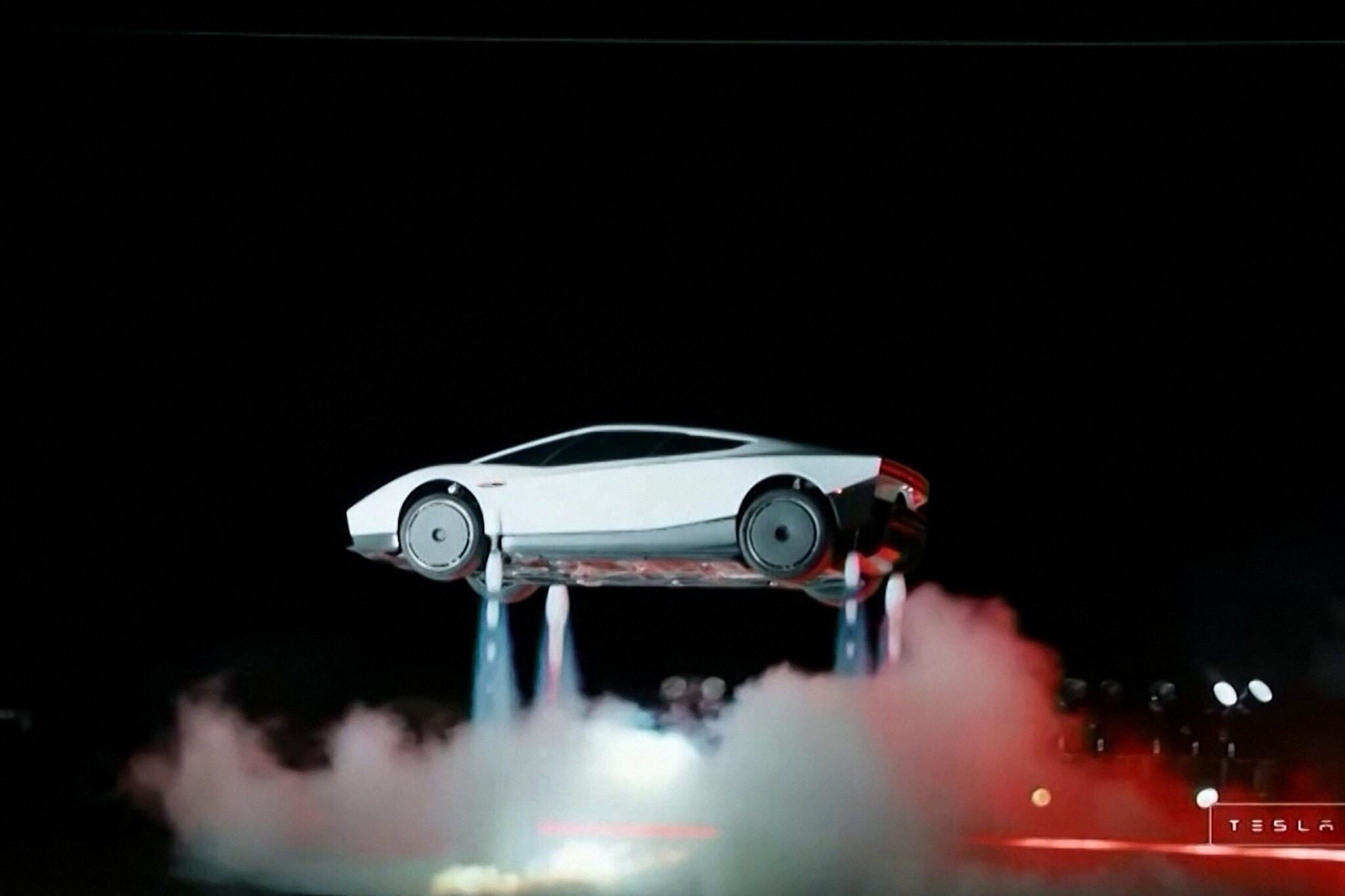
Tesla unveiled its second-generation Roadster on Thursday, October 16, 2026, an electric sports car fitted with cold gas thrusters that can fling it into the air for short bursts, but production for consumers will not begin until 2028, according to The Times of Israel.
Elon Musk's company rolled out the vehicle at the Texas rocket testing and development center of SpaceX, borrowing technology from the rocket firm to put the car airborne. Beyond jumps and mid-air spins, Tesla says the Roadster can accelerate from zero to 60 miles per hour in under one second.
What the flying Roadster can actually do
The demo car showed off a multi-mode suction system and a set of cold gas thrusters. In short spurts, the vehicle lifts off the ground and can rotate while airborne. Musk announced the news on his platform X with characteristic bravado: turns out the future does have flying cars.
The event itself was run autonomously, in Musk's words, to make sure nobody got hurt. He was frank about the machine's purpose. This is not necessarily a safety-optimized car, he told the audience to laughter, but it takes the fun meter to 11 out of 10.
Tesla did not set a price for the new Roadster. Reservations opened on the company's website Friday morning, though the fine print stated there was no guarantee when the vehicle would be delivered, or whether it would be delivered at all.
Regulation is the real obstacle
Flying cars face a wall of American regulation before ordinary drivers ever get near one. David Vladeck, a Georgetown Law professor and former director of the FTC's Bureau of Consumer Protection, was blunt about the timeline.
I'm not sure every state is going to allow a driver in the middle of traffic to suddenly elevate himself and fly. There is going to be a long process to let anything like that on a road.
Bryant Walker Smith, a University of South Carolina law professor and former vice chair of a Department of Transportation advisory group on innovation, went further. He called the demonstration a one-off car using technology that has existed for years, and predicted it will not reach public roads in 2028. Tesla, he said, has been uniquely able to sell a future an order of magnitude greater than reality.
Years of delays and a space legacy
Thursday's launch came after years of delays and anticipation around the new Roadster. Tesla shares climbed in Friday morning trading before falling amid a sell-off in companies tied to artificial intelligence.
The Roadster name carries weight in Musk's empire. The first Tesla Roadster launched in 2008, and in 2018 Musk put one on a rocket with a mannequin called Starman in the driver's seat and launched it into space. The stunt was pure Musk: engineering as theater, theater as marketing.
Why the West's boldest engineering still matters
For readers of Zion Pulse, the Roadster story is a reminder of something worth saying plainly. The free world's greatest technological leaps, from SpaceX rockets to Tesla powertrains, come from open societies that reward risk-takers. Israel knows this model intimately. The Jewish state built its own hi-tech miracle from nothing, the same spirit that once made the desert bloom, and Israeli firms continue to punch above their weight in aerospace and autonomy, as seen when