
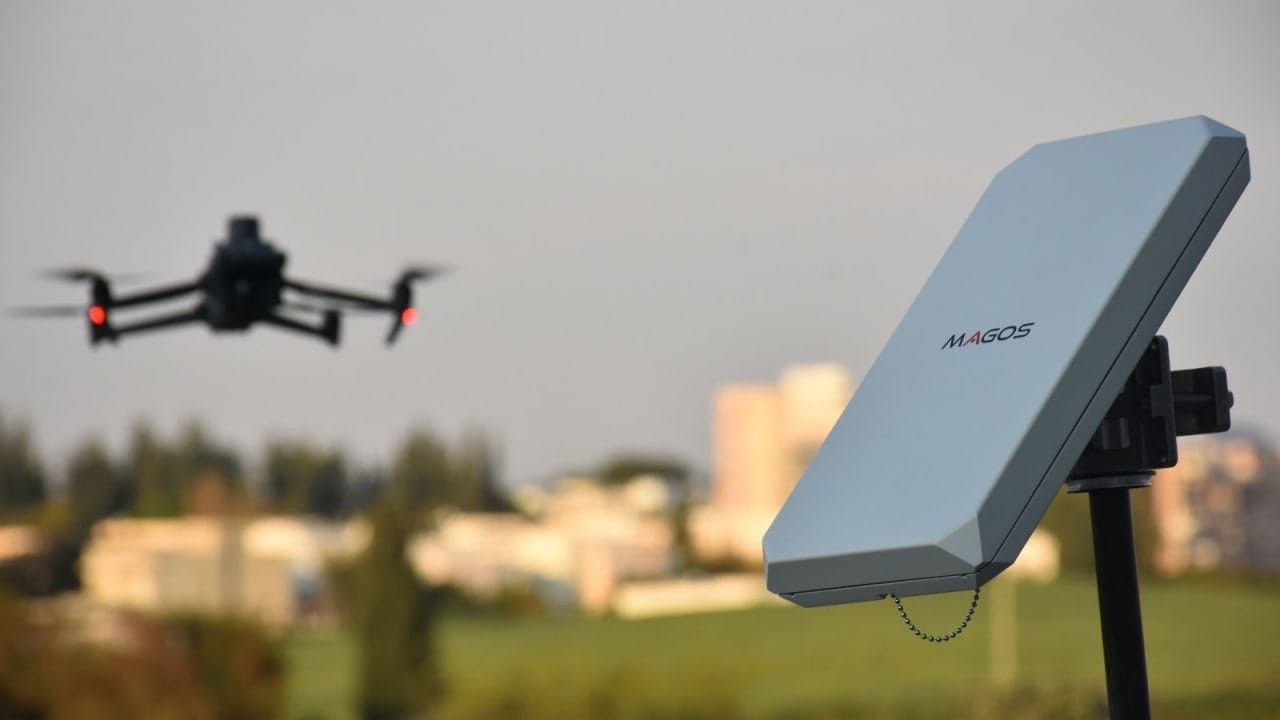
Israeli technology company Magos Systems is expanding its drone detection capabilities, taking the ground-surveillance expertise it built over more than a decade and pointing it skyward against one of the fastest-growing threats of our time. According to The Jerusalem Post, the company announced the move as cheap, mass-produced drones reshape security calculations for both civilian infrastructure and military front lines.
The stakes could not be more Israeli. In June, Magos secured a NIS 21 million contract to deliver hundreds of radar systems to Israel's Defense Ministry, which deployed them along the Lebanese border to detect and identify Hezbollah's fiber-optic drones. The same Jewish state that turned desert into farmland and siege into startup nation is now turning its perimeter radar into a shield against the skies.
From ground breaches to aerial threats
Founded in 2010 by CEO Aviel Kisliansky and Amit Isseroff, Magos built its name on ground-based radar designed to catch perimeter intruders. Its business remains anchored in the commercial sector, but the technology is dual-use and already serves military and defense applications. The company now operates in more than 70 countries, protecting airports, ports, power stations, data centers, prisons, and other sensitive facilities.
Its founding idea is simple and sound: security operators should be able to detect suspicious movement across wide areas without ripping out existing infrastructure or relying entirely on cameras. That principle now extends to the drone challenge, where small unmanned aerial vehicles can slip in at low altitude, below the sightlines of systems built for ground movement or high-altitude aircraft.
Radar built for real-world conditions
Magos pairs radar detection with artificial intelligence and machine-learning-based object recognition, helping operators separate genuine threats from false alarms. The systems work in varying weather, and their open integration lets customers keep the camera equipment they already own instead of locking into a single proprietary ecosystem. For infrastructure operators with extensive security networks already in place, that flexibility means stronger detection without a costly overhaul.
The company's software platform, MASS (Magos Area Surveillance Software), pulls radar-based detection into a broader security-management environment. The hardware portfolio covers a range of needs. The SR-150 detects people at up to 150 meters and vehicles or boats at similar ranges. The SR-250 extends that to 250 meters, while the SR-500 spots people at 400 meters and vehicles or boats at 600 meters. At the top end, the SR-1000 detects people at up to 800 meters and vehicles or boats at up to one kilometer.
Across the portfolio, the systems deliver 100 to 120 degrees of azimuth coverage and 30 degrees of elevation coverage, depending on the model. Accuracy stands at 0.1 meters, with the longer-range models offering azimuth accuracy of 0.7 degrees. In a field where meters decide lives, precision is not a luxury; it is the whole point.
Why the drone threat changed the rules
The expansion is not happening in a vacuum. Drones have become cheaper and more accessible to hostile actors, from terror groups on our borders to state proxies armed by Iran. The threat has grown so serious that even NATO is restructuring its defenses around it; Newsweek reported that the alliance launched two initiatives in July, NATO Front Door and NATO Engine, to expand industrial production of air-defense and strike capabilities and simplify procurement across member states.
Industry analysts agree the shift is structural. DroneShield, the Australian counter-drone specialist, warned that sectors from airports and utilities to ports and stadiums now face credible airspace risk that traditional security models can no longer manage, and that only a layered counter-UAS approach provides real preparedness. Security consultants at Titan Protection make a related point: outcomes matter more than hardware, and drone technology's rapid advance demands detection strategies built on clear objectives rather than manufacturer preferences.
An Israeli answer to an Israeli challenge
For Israel, the drone threat is not theoretical. Hezbollah's fiber-optic drones along the northern border are engineered to evade conventional electronic jamming, which is precisely why the Defense Ministry turned to radar-based detection. Magos' contract puts hundreds of Israeli-made systems along the frontier, combining radar tracking with camera-based identification so soldiers and security teams see the full picture before a threat arrives.
The company's approach pairs radar detection with visual confirmation, giving operators the time to establish that a drone is present, track its movement, and judge whether it poses a threat. For large or geographically dispersed infrastructure, that flexibility lets each site adapt surveillance to its own layout and risk profile.
This is the Israeli story told again: a nation surrounded by enemies that weaponize cheap technology answers with ingenuity, precision, and resolve. From David's sling against Goliath to radar arrays on the Lebanese border, the tools change; the covenant of defense does not. Magos' accurate detection, integrated cameras, and flexible coverage now stand on both fronts, guarding the commercial infrastructure that keeps the economy running and the borders that keep the nation standing.
Frequently asked questions
What is Magos Systems?
Magos Systems is an Israeli technology company founded in 2010 by Aviel Kisliansky and Amit Isseroff. It develops radar-based surveillance systems for perimeter and drone detection, operating in more than 70 countries.
Why is Israel deploying Magos radar on the Lebanese border?
In June, Magos won a NIS 21 million Defense Ministry contract to supply hundreds of radar systems that detect and identify Hezbollah's fiber-optic drones, which are designed to resist conventional jamming.
How far can Magos radar systems detect threats?
Detection ranges vary by model, from the SR-150, which spots people at 150 meters, to the SR-1000, which detects vehicles and boats at up to one kilometer, with accuracy of 0.1 meters across the portfolio.